

Crown TO CLASSROOM
May 4, 2014
Delhi Needs Redevelopment, Not Band-Aid
May 6, 2014**BREAKING THE MALE GAZE:**
How Indian Women Are Reclaiming Their Narrative
THE GAZE GOES ONLINE**
The male gaze has found new expressions in the Digital Age. Women’s social media profiles have become hunting grounds for unsolicited comments about their appearance. Instagram and Facebook inboxes are filled with inappropriate photos and messages from strangers who feel entitled to women’s attention.
Professional women face a barrage of comments that focus on their appearance rather than their achievements. Even teenage girls aren’t spared, with older men sliding into DMs with “compliments” that are actually predatory behaviour.
In fact, an investigation by India Today’s OSINT team found 23 social media accounts whose creators resorted to unauthorised recording of women in public after struggling to attract viewers with their regular content.
The recent September 7th case in Delhi, where authorities found 74 secretly filmed videos recorded via a camera embedded in footwear, exemplifies technology’s role in facilitating covert sexual abuse.
Parliamentary reports show that severe cybercrimes, including sextortion scams and cyber attacks have quadrupled in the last four years. The male gaze extends even to minors, sexualising and exploiting children through digital platforms.
Between 2018 and 2022, authorities recorded over 3,000 cases involving child pornography distribution, alongside more than 500 instances of cyber stalking targeting minors under 18.
UNDERSTANDING THE CONCEPT OF THE “MALE GAZE”
The concept of the “male gaze” first articulated by film theorist and feminist critic, Laura Mulvey in 1975, describes how perspectives are often filtered through a heterosexual male viewpoint. Laura Mulvey initially defines the term to predominantly refer to the gaze of the male, thus suggesting that the very concept of gaze is gendered.
Phallocentric narratives prioritize male narratives while silencing women’s voices, reducing them to sexual objects or background figures valued only by their appeal to men. Drawing on Foucault’s panopticon theory and psychoanalytic frameworks, Laura Mulvey argued that visual observation generates sexual pleasure, demonstrating how media objectifies women by emphasizing physical attributes while relegating them to passive roles.
While the ‘male gaze’ originated as an academic concept bridging feminist theory and film studies, it has now entered quotidian discussions. This concept transcends film studies, applying to all forms of media representation and women’s lived experiences.
THE MALE GAZE AS HARASSMENT: BEYOND THEORY TO DAILY REALITY
The “male gaze” isn’t just an academic concept. It is a lived experience that begins early and continues throughout a woman’s life. It’s the uncle at the family gathering who stares for an uncomfortably long time, the auto-rickshaw driver who adjusts his rearview mirror to watch female passengers as he pleasures himself, or the colleague who “accidentally brushes against” a female coworker.
It is also the hidden cameras recording women in changing rooms and public restrooms and the revenge sharing of intimate images when relationships end. This gaze reduces women to objects for male consumption, stripping away their humanity and right to move freely in public spaces.
These aren’t isolated incidents. These are systematic patterns of behaviour that communicate to women that the public space doesn’t truly belong to them.
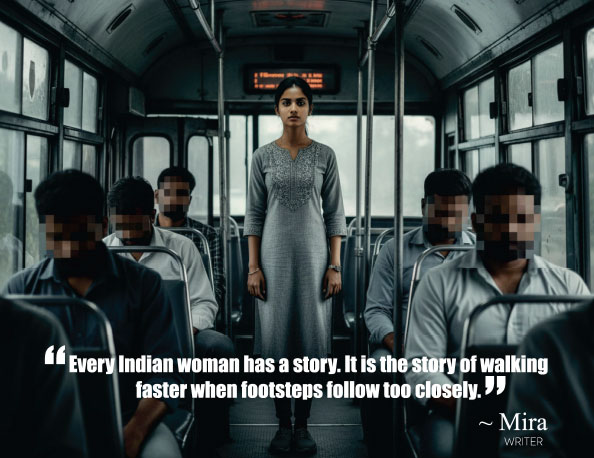
“Every Indian woman has a story. It is the story of walking faster when footsteps follow too closely.” ~ Mira WRITER
**DIGITAL HARASSMENT: THE GAZE GOES ONLINE**
The male gaze has found new expressions in the Digital Age. Women’s social media profiles have become hunting grounds for unsolicited comments about their appearance. Instagram and Facebook inboxes are filled with inappropriate photos and messages from strangers who feel entitled to women’s attention.
Professional women face a barrage of comments that focus on their appearance rather than their achievements. Even teenage girls aren’t spared, with older men sliding into DMs with “compliments” that are actually predatory behaviour.
In fact, an investigation by India Today’s OSINT team found 23 social media accounts whose creators resorted to unauthorised recording of women in public after struggling to attract viewers with their regular content.
The recent September 7th case in Delhi, where authorities found 74 secretly filmed videos recorded via a camera embedded in footwear, exemplifies technology’s role in facilitating covert sexual abuse.
Parliamentary reports show that severe cybercrimes, including sextortion scams and cyber attacks have quadrupled in the last four years. The male gaze extends even to minors, sexualising and exploiting children through digital platforms.
Between 2018 and 2022, authorities recorded over 3,000 cases involving child pornography distribution, alongside more than 500 instances of cyber stalking targeting minors under 18.
THE PATH FORWARD: FROM SURVIVAL TO THRIVING
THE GAZE GOES ONLINE**
The male gaze has found new expressions in the Digital Age. Women’s social media profiles have become hunting grounds for unsolicited comments about their appearance. Instagram and Facebook inboxes are filled with inappropriate photos and messages from strangers who feel entitled to women’s attention.
Professional women face a barrage of comments that focus on their appearance rather than their achievements. Even teenage girls aren’t spared, with older men sliding into DMs with “compliments” that are actually predatory behaviour.
In fact, an investigation by India Today’s OSINT team found 23 social media accounts whose creators resorted to unauthorised recording of women in public after struggling to attract viewers with their regular content.
The recent September 7th case in Delhi, where authorities found 74 secretly filmed videos recorded via a camera embedded in footwear, exemplifies technology’s role in facilitating covert sexual abuse.
Parliamentary reports show that severe cybercrimes, including sextortion scams and cyber attacks have quadrupled in the last four years. The male gaze extends even to minors, sexualising and exploiting children through digital platforms.
Between 2018 and 2022, authorities recorded over 3,000 cases involving child pornography distribution, alongside more than 500 instances of cyber stalking targeting minors under 18.
BEYOND INDIVIDUAL SAFETY: SYSTEMIC CHANGE
The ultimate goal isn’t just surviving harassment but creating a society where women don’t have to develop survival strategies in the first place. This means changing the fundamental assumption that women’s bodies are public property available for comment and consumption.
Women are demanding the right to exist in public spaces without constant vigilance, to wear clothes without calculating the risk of harassment, and to say ‘no’ without facing retaliation.
While individual women are finding ways to protect themselves and fight back, they are also working toward systemic change. This includes better street lighting, more police patrolling, surveillance cameras in public spaces, and harassment prevention training in educational institutions. Despite promises to install lighting and bus marshals after the 2013 Nirbhaya case, many commitments remain unfulfilled. Women activists argue CCTV surveillance alone cannot prevent crimes, highlighting significant work still needed. Nevertheless, women are running for local office to implement these changes, starting organisations focused on women’s safety.
THE REVOLUTION CONTINUES
Every woman who refuses to accept harassment as normal, who documents and reports inappropriate behaviour, who supports other women’s right to speak up, contributes to this larger change.
The male gaze may have normalised harassment for generations, but Indian women are proving that they have the power to denormalise it. Women are now reclaiming not just their narratives but their fundamental right to move through the world without fear.
This isn’t just about individual empowerment. It is about creating a society where every woman can exist in public spaces with dignity and safety. And that revolution, one woman’s refusal at a time, is already underway.
VIEWS EXPRESSED ARE PERSONAL.